

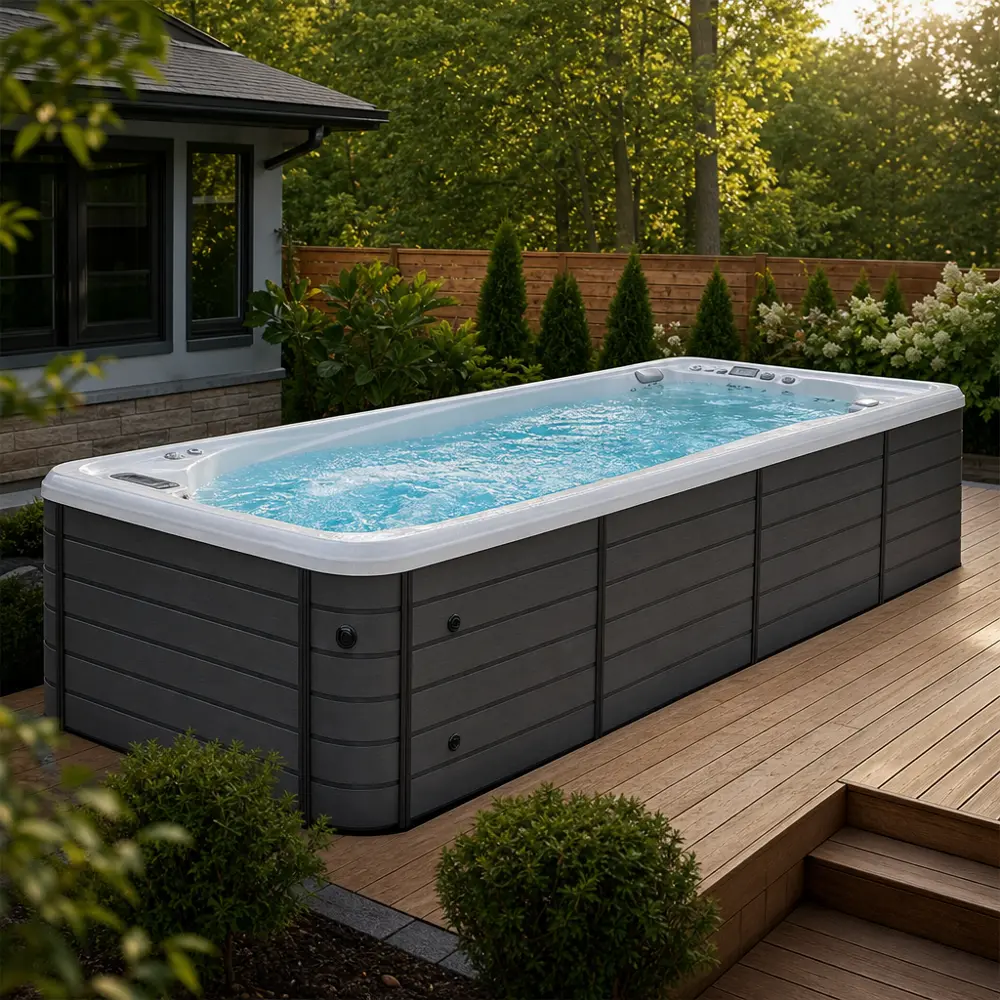
When most people think about swimming, they imagine either a public pool or a sprawling in-ground installation that requires years of planning and tens of thousands in construction costs. An acrylic backyard swim spa offers a different path entirely. It delivers genuine swimming capability in a compact, self-contained unit that fits into a standard residential outdoor space.
The appeal isn’t just novelty. Homeowners today want flexibility—the ability to exercise, entertain guests, and unwind without leaving their property. A quality acrylic backyard swim spa bridges the gap between a standard hot tub and a full swimming pool, giving you active water-based exercise during the day and hydrotherapy relaxation in the evening.
A swim spa operates through a central principle: powerful, directional water jets create a current that allows you to swim in place. Unlike lap pools, which require 25 meters or more of length, a swim spa generates resistance within a compact footprint. You swim against the current, and the water essentially moves toward you while you remain in roughly the same position.
The effectiveness depends entirely on pump power and jet configuration. Most residential units use multiple jet systems—typically a primary swim jet that generates the main current, supported by smaller jets that provide targeted muscle stimulation. The continuous recirculation means you’re not fighting stagnant water; you’re engaging with a controlled, predictable flow that mimics open-water conditions at a fraction of the scale.
Controlling this flow is critical. Modern systems use digital interfaces that let you adjust jet intensity, water temperature, and circulation patterns from a single control panel. The Balboa BP6013 G3 system, which handles intelligent automation in professional-grade installations, is an example of how manufacturers ensure consistent performance without requiring constant manual adjustment.
The shell material determines how well your spa withstands years of exposure to sun, chlorine, and temperature fluctuations. Acrylic isn’t a casual choice for this application—it’s specifically selected because of its balance between clarity, strength, and thermal properties.
High-strength acrylic from suppliers like Aristech (a US-based manufacturer) comes with formulations designed to resist UV degradation and color fading. Over extended outdoor exposure, lower-grade plastics become brittle and discolored; premium acrylic maintains its appearance and structural integrity for a decade or longer with proper maintenance.
The spa’s construction extends beyond the visible shell. The interior relies on multiple layers: an epoxy resin coating protects the acrylic surface, while fiberglass reinforcement adds rigidity. Below that sits foam insulation, which directly impacts your operating costs by reducing heat loss. When manufacturers claim 30% energy savings through multi-layer insulation, they’re referring to this sandwich structure—the foam acts as a thermal barrier that keeps heated water from dissipating into the cold air or ground.
The frame supporting the entire assembly also matters. Galvanized steel resists rust in humid outdoor environments far better than standard steel. Even the base skirt—the visible exterior panels—uses UV-stable materials that won’t crack or warp under direct sunlight. These details seem minor until you’re five years into ownership and realize your investment looks and performs as well as day one.
Raw specifications can feel overwhelming, but they translate into real-world capability. Consider capacity and seating first: a three-person swim spa with dimensions around 4500 mm × 2280 mm × 1400 mm offers enough space for one person to swim while two others relax. That’s different from a soaking hot tub where everyone sits in close proximity.
Jet pump power, measured in horsepower, directly correlates to swim intensity. Two 3-horsepower pumps generating flow through four jets creates a current strong enough for meaningful resistance training. A smaller 0.35-horsepower circulation pump handles water filtration and heating during quiet periods when you’re not actively swimming. This two-tier pump arrangement keeps costs manageable while preserving performance.
The heating system deserves attention because it’s often underestimated in impact. A 3-kilowatt heater can raise water temperature by roughly 1–2 degrees Celsius per hour under standard conditions. In climates where outdoor temperatures drop significantly at night, this becomes the difference between year-round usability and seasonal-only operation. Higher wattage heaters exist but consume more electricity; the 3-kilowatt specification represents a practical balance for residential settings.
Filtration capacity—listed here as two filters with 100 square feet each—determines how often you can fully turnover the water. Larger filters mean extended intervals between cleaning, which translates to lower maintenance effort and longer filter life.
| Component | Specification | Practical Impact |
|---|---|---|
| Shell Material | US Aristech Acrylic | UV resistance, color retention, 10+ year durability |
| Capacity | 3 Person | Comfortable for one swimmer plus two observers or bathers |
| Jet Pumps | 2 × 3 HP | Adequate current for cardiovascular swimming exercise |
| Circulation Pump | 0.35 HP | Efficient water filtration during non-active periods |
| Heater | 3 kW | 1–2°C per hour heating rate for temperate climates |
| Filters | 2 × 100 sq ft | Balanced cleaning intervals, reduced maintenance frequency |
| Control System | Balboa BP6013 G3 + TP600 | Digital automation, stable performance, intuitive interface |
Electricity consumption concerns many potential buyers, and rightfully so. A swim spa isn’t a stationary fixture like a traditional hot tub; the jets run during use, and the heater operates continuously to maintain temperature, especially in cooler seasons.
However, multi-layer insulation directly reduces heating demand. When the spa loses less heat through the shell and surrounding materials, the heater doesn’t need to run as frequently to maintain your target water temperature. The claimed 30% reduction in heat loss reflects the cumulative effect of acrylic shell quality, epoxy coating, fiberglass reinforcement, and foam insulation working together.
Real-world operating costs depend on local electricity rates, climate conditions, and usage patterns. In moderate climates with regular use but reasonable ambient temperatures, owners typically report monthly electricity costs ranging from moderate to higher levels depending on regional pricing. That’s noticeably higher than an unheated pool but comparable to operating a traditional hot tub with jets and heating.
One often-overlooked factor is partial operation. You don’t need to keep the swim jets running all the time. Many users run the circulation system passively to maintain temperature and filter water, then activate the swim jets only during active swimming sessions. This approach reduces energy consumption while preserving water quality.
Before purchasing an acrylic backyard swim spa, decisions about placement and setup determine whether it functions as intended. The unit requires level ground to ensure even weight distribution and prevent stress on the acrylic shell. Concrete pads work well; wooden decks are acceptable if the deck can support the filled weight, which for a three-person model reaches approximately 5,750 kilograms.
Electrical requirements vary by model and regional voltage standards. Three-phase 380V supply offers advantages in some countries, while single-phase 220V or 110V may be standard in others. You’ll need to verify that your home’s electrical infrastructure supports the chosen configuration before purchase. Many installations require a dedicated circuit breaker and professional wiring to ensure safe, uninterrupted operation.
Drainage presents another practical consideration. The spa needs access to either a standard drain or a subsurface disposal area. During initial fill and periodic water changes, you’re managing thousands of liters that must go somewhere. Sloped ground or proximity to garden beds can work, though some installations include submersible pumps to direct water to more convenient locations.
Chemical treatment is simpler than managing a traditional pool because the volume is smaller and circulation is faster. Most owners use chlorine or bromine systems similar to hot tub maintenance, requiring adjustments roughly every few days depending on usage frequency. The UV sterilizer—included in professional installations—supplements chemical treatment by neutralizing organisms through ultraviolet light exposure, reducing chemical load and odor concerns.
Fitness-focused users treat acrylic swim spas as personal training tools. Someone recovering from an injury can perform low-impact cardiovascular exercise using the swim jets without stress on joints. Competitive swimmers use them for technique refinement and conditioning during off-season periods when pool access is limited.
Entertainment value shouldn’t be dismissed either. A backyard swim spa creates a focal point for social gatherings. Guests experience something between a hot tub and a pool, which generates genuine interest and conversation. Unlike a traditional pool that sits empty most of the time, a well-maintained spa sees regular use for relaxation, casual swimming, and family time.
Wellness applications reflect growing interest in regular hydrotherapy. Jet massage targeting specific muscle groups supports recovery after workouts, while warm water immersion reduces stress and improves sleep quality. For people with aging relatives or mobility challenges, a spa with low-entry step design allows pain-free access to therapeutic water experience.
Business applications exist too. Some property owners install acrylic swim spas at rental vacation homes to justify premium pricing and attract guests seeking active wellness amenities. Hotels and resorts position them as high-end relaxation features that differentiate their offerings.
Owning an acrylic backyard swim spa requires consistent but straightforward maintenance. Weekly tasks include testing and adjusting pH, chlorine or bromine levels, and checking filter pressure. Most systems include pressure gauges that alert you when filters need cleaning—typically every two to four weeks depending on usage.
Monthly maintenance involves inspecting jets for debris buildup, checking water level (evaporation occurs naturally), and cleaning the skimmer basket if present. Annual tasks include deep-cleaning filters or replacing them entirely, checking pump seals, and verifying heater performance.
The acrylic shell itself needs minimal care. Avoid abrasive cleaners that can scratch the surface; mild soap and soft cloths handle exterior dirt. For interior surfaces, standard pool brushes work fine. Avoid leaving the spa uncovered for extended periods in direct sunlight, as UV exposure—while resisted by quality acrylic—accelerates degradation over time. A fitted cover provides both thermal insulation and UV protection when the spa isn’t in use.
Water care varies by location. Hard water areas may require periodic acid balancing, while areas with mineral-heavy groundwater need occasional system flushing. Most manufacturers provide guidance specific to regional water chemistry.
People often ask whether an acrylic backyard swim spa can truly support serious swimming. The answer depends on expectations. If you’re training for competitive racing, you need more space than any compact model provides. But for cardiovascular conditioning, technique work, and regular exercise, modern swim spas deliver comparable intensity to open water—you’re simply stationary while the water moves toward you.
Another frequent question concerns year-round operation in cold climates. It’s possible but costly. A 3-kilowatt heater struggles to maintain comfortable temperatures when outdoor air drops below freezing. Upgrading to higher-wattage heaters increases capability but also increases electricity consumption. Most users in harsh climates either upgrade heating systems or treat their spa as a three-season installation.
Noise concerns emerge periodically. Running jets do generate sound—typically in the range of normal conversation volume to moderate background noise. High-quality pump isolation can reduce this somewhat, but complete silence isn’t realistic. Early morning or late evening operation may disturb neighbors depending on property spacing and local noise ordinances.
Installation timeline typically spans one to two weeks after delivery. Site preparation—leveling ground, running electrical supply, setting up water access—happens first. The unit itself arrives fully assembled and ready for filling. Initial startup includes filter flushing, system checks, and water chemistry balancing before the first swim.
An acrylic backyard swim spa costs significantly less than in-ground pool installation but more than basic hot tubs. Initial investment typically ranges from mid-to-high tier for home improvements, positioning it as a lifestyle choice rather than a must-have utility.
Where value materializes is through extended usability and lower maintenance burden compared to traditional pools. You’re using active heating and filtration rather than relying on weather and passive circulation. The spa remains functional year-round in most climates with minimal seasonal preparation or winterization.
Resale impact is mixed. Homes with well-maintained spas sometimes see modest appreciation among buyers seeking ready-made wellness amenities. However, real estate markets vary significantly, and spas appeal to specific buyer profiles. Unlike major renovations, a spa shouldn’t be purchased primarily for resale value.
The genuine return comes from use—consistent swimming and relaxation that would otherwise require expensive gym memberships, hotel pool visits, or large-scale pool construction. For people committed to regular aquatic exercise and outdoor wellness, an acrylic backyard swim spa delivers tangible lifestyle value that justifies the investment.
Choosing an acrylic backyard swim spa depends on matching your needs to realistic capabilities. Assess whether you’ll genuinely use it for swimming, hydrotherapy, or entertainment. Verify that your property has suitable space, electrical capacity, and drainage options. Calculate operating costs based on your climate and local utility rates.
Beyond specifications, consider the quality markers: durable acrylic construction, proven control systems, multi-layer insulation, and genuine aftermarket support. These factors determine whether your spa remains a valuable asset or deteriorates into an expensive backyard eyesore within a few years.
The rise of acrylic backyard swim spa ownership reflects a broader shift toward personalized wellness experiences. People increasingly prioritize convenient access to fitness and relaxation over traditional approaches. A well-chosen spa fits into that lifestyle, offering genuine swimming capability combined with therapeutic relaxation—all without the complexity and expense of conventional pool ownership.