

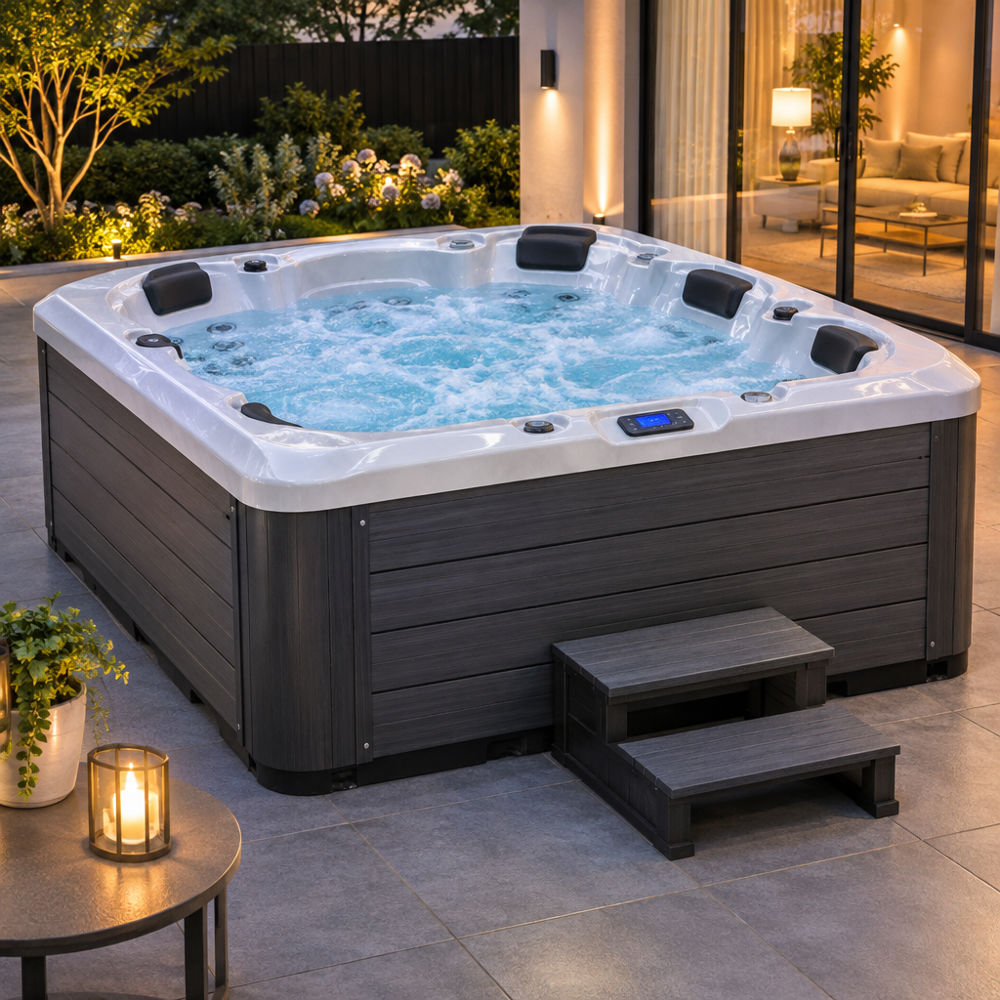
Investing in a modern whirlpool spa tub transforms an ordinary residential patio or commercial terrace into a dedicated hydrotherapy station. Unlike temporary inflatable pools or standard indoor bathtubs that drain after a single soak, an exterior whirlpool spa tub relies on mechanical filtration, precision thermal regulation, and high-pressure hydraulic delivery. Whether you evaluate a multi-person spa tub for physical recovery or family leisure, understanding pump mechanics, frame engineering, electrical requirements, and water chemistry ensures long-term operational reliability.
Selecting the right hydrotherapy system requires navigating complex mechanical parameters and structural preparations. From dry weight considerations to hydraulic circulation balance, every component choice dictates daily efficiency, equipment longevity, and user comfort across diverse seasons.
A self-contained outdoor whirlpool spa tub is an integrated thermal vessel engineered to maintain treated water over extended periods. The spa uses pumps, filtration, heating, and UV-treatment components to manage the water system, though the exact flow sequence depends on the installed configuration. Many outdoor spas place their mechanical components beneath the cabinet skirt to protect plumbing connections, maintain thermal stability, and support uniform water warmth throughout changing ambient outdoor weather conditions.
Indoor drop-in jetted bathtubs share basic hydraulic concepts, yet their operating models differ completely in practice and maintenance. An indoor jetted bathtub is normally filled for an individual use and then drained through the building’s approved drainage system. In contrast, an outdoor whirlpool spa holds its water volume continuously over several months, actively sanitizing, filtering, and reheating the fluid against surrounding ambient weather shifts.
Industry nomenclature often confuses prospective buyers because commercial brand names, colloquial phrases, and engineering terms frequently overlap in casual conversation. The word Jacuzzi represents a proprietary registered trademark of a specific equipment manufacturer rather than a generic product category. The term "hot tub" can refer to a broad range of heated soaking vessels, while a modern spa commonly includes molded seating, pumps, jets, filtration, and heating controls.
In contemporary mechanical engineering, an outdoor whirlpool spa tub denotes an ergonomically contoured, molded synthetic vessel equipped with multiple hydrotherapy jets. Many spa designs utilize Venturi air-injection principles within internal plumbing loops to draw ambient air into pressurized water streams, though specific jet mechanics vary by model. These systems produce concentrated kinetic streams designed to invigorate muscular tissue and provide soothing buoyancy during extended soaking sessions.
Residential homeowners generally install a private whirlpool spa tub on ground-level concrete patios, reinforced garden decks, or private master terraces. Primary residential objectives focus on personal stress relief, post-workout relaxation, and quiet evening leisure with family members. Some control configurations support programmable filtration cycles, but buyers should confirm the specific operating schedule, energy profile, and noise characteristics with the manufacturer.
Commercial hospitality operators approach these hydrotherapy installations from a demanding operational perspective. Boutique hotels, mountain chalets, holiday rental villas, and wellness clubs demand heavy bather-load tolerance, tamper-proof control panel lockouts, rapid filtration turnover rates, and strict adherence to regional health department sanitation standards. In hospitality environments, equipment reliability is vital to prevent downtime and protect guest satisfaction.
Interior usable volume matters far more than external shell dimensions when assessing overall bather accommodation. A poorly planned shell mold might span large external measurements yet feel uncomfortably cramped if thick wall perimeters or inefficient footwell contours restrict occupants’ lower limbs. Evaluating internal dimensions ensures that all intended bathers sit without crowding one another during group sessions.
Ergonomic molds must support natural human physiology through varied water depths and seating contours. Contoured seating and headrest pillows are intended to improve comfort and positioning during hydrotherapy sessions. Proper bucket seating stabilizes the upper torso, while integrated soft headrests support the neck, reducing muscle fatigue and keeping bathers comfortable while water circulates through active massage jets.
Marketing brochures frequently emphasize high jet counts, but jet count alone does not establish massage performance. An excessive number of nozzles paired with undersized pumps yields weak water pressure rather than deep massage action. Ask the manufacturer for pump ratings, flow data, and the jet-layout or hydraulic diagram before making pressure comparisons between prospective models.
Multi-pump systems decouple low-energy filtration duties from high-intensity hydrotherapy cycles. The specification lists one 0.35 HP circulation pump and one 100 sq. ft. cartridge filter; confirm the operating schedule and flow path in the installation or operating manual. Meanwhile, independent high-output jet pumps activate only when users initiate targeted hydrotherapy sessions, providing forceful water circulation without placing continuous wear on primary massage motors.
The composition of the internal shell directly determines long-term structural integrity and resistance to chemical etching. The ZR6007 uses a US Aristech Acrylic shell; ask the manufacturer for the material-care and chemical-compatibility guidance before selecting cleaning products. Prospective buyers should also ask for the shell-construction details and warranty terms covering cracking, crazing, or delamination under varying thermal conditions.
Underneath the molded shell, the structural framework carries the extensive dead weight of water and occupants. The listed aluminum frame and New PS skirt are intended for outdoor use; confirm local climate suitability, warranty coverage, and maintenance requirements with the manufacturer. Exterior skirts made from synthetic polystyrene (New PS) provide the visual look of wood grain while resisting weather-induced deterioration.
The central electronics pack functions as the operational brain of any modern whirlpool spa tub. Control systems such as the Balboa BP6013G2 are designed to manage spa heating and pump functions; verify the certifications and installed configuration for the specific unit. The control system manages the listed heater and pump functions; actual temperature stability and energy use depend on the configured controls, insulation, cover, ambient conditions, and usage.
Operating in cold winter conditions requires adequate electrical infrastructure to maintain water warmth while running massage jets. A 3 kW heater working alongside multiple high-output pumps draws substantial electrical power. Electrical designs must accommodate appropriate single-phase or three-phase line feeds, paired with dedicated circuit breakers, to prevent nuisance tripping when multiple components operate concurrently.
| Engineering Feature | Standard Entry-Level Tubs | High-Performance Whirlpool Spa Tubs |
|---|---|---|
| Shell Composition | Basic rotomolded plastic or thin composite | US Aristech Acrylic shell |
| Structural Framework | Untreated soft timber or light steel wire | Extruded structural aluminum alloy (such as 40 mm × 20 mm) |
| Pumping Architecture | Single shared dual-speed motor | Dedicated circulation pump plus independent massage jet pumps |
| Cabinet Skirt Material | Thin vinyl wrap or standard exterior timber | Weather-resistant engineered polystyrene (New PS) panels |
| Control Electronics | Unbranded proprietary analog boards | Globally supported digital platforms (e.g., Balboa BP6013G2 + TP600) |
| Sanitation Architecture | Manual chemical floater dispenser only | 100 sq. ft. cartridge filtration with supplemental UV sterilization |
To examine how these engineering parameters translate into a production model, consider the LOVIA ZR6007. The manufacturer’s product page lists the ZR6007 as a 7-person spa with 7 seats, despite the contradictory "5 Person" title found on some legacy product pages. Its open interior geometry provides seven individual seating positions around a central shared footwell.
Measuring 2300 mm by 2300 mm with an 880 mm sidewall height, the vessel establishes a squared footprint suitable for spacious backyards, paved pool decks, and hospitality terraces. This footprint balances physical space and massage utility for private residential owners and resort operators alike, ensuring every bather has adequate elbow room and ergonomic leg space during extended group soaking sessions.
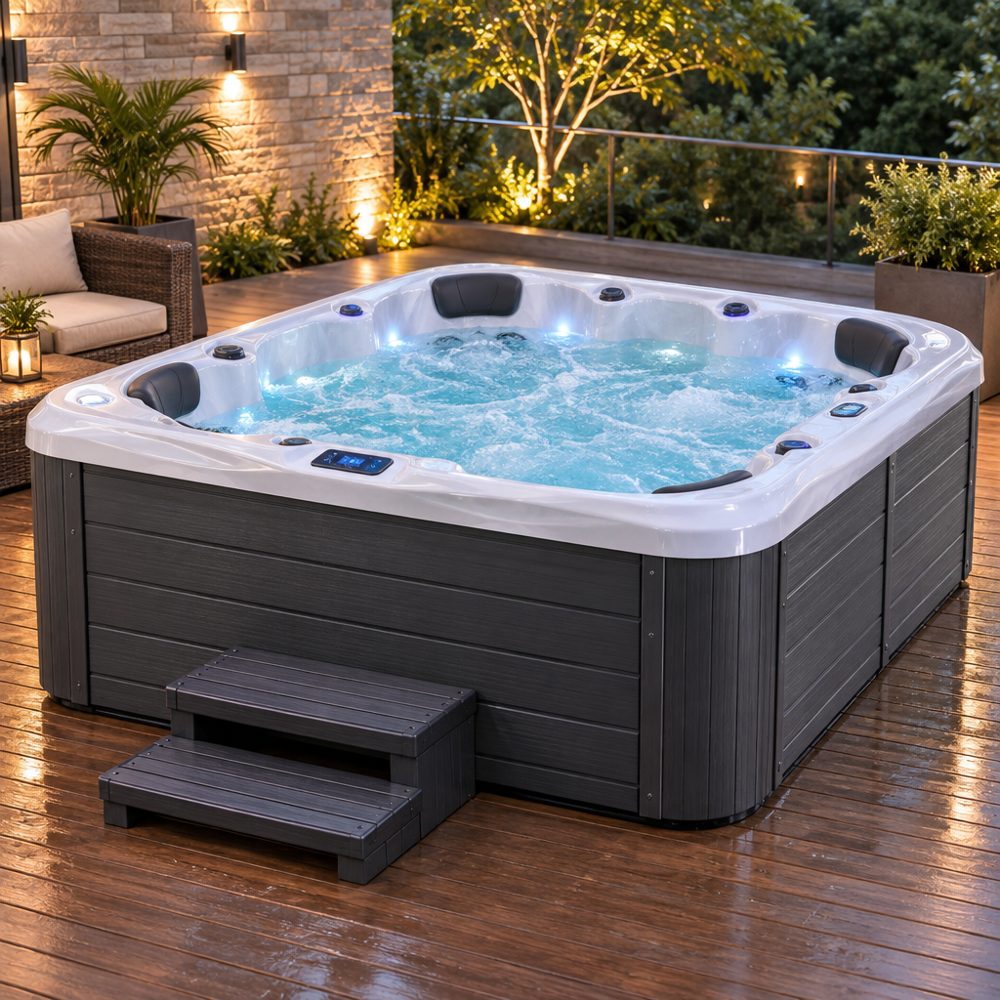
Reviewing the ZR6007 through its verified production specifications demonstrates how a modern high-capacity vessel balances hydraulic output, physical structure, and mechanical dimensions:
The 66 hydrotherapy jets inside the ZR6007 are arranged to deliver point-to-point massage targeting key anatomical zones identified in the manufacturer’s engineering layout. The jet layout is marketed for massage around the cervical spine, lower back, and calves. Users should not treat the spa as a medical device or assume it treats an injury, but rather enjoy the therapeutic soothing sensation of warm, pressurized water.
Water streams directed toward the cervical spine help soothe tense neck and shoulder muscles, while lower-back jet clusters target the lumbar region to relieve everyday muscular stiffness. Calf-area jets focus water flow along the lower legs, promoting physical comfort. Bathers should use these massage stations for personal relaxation and muscle comfort after long workdays or athletic training sessions.
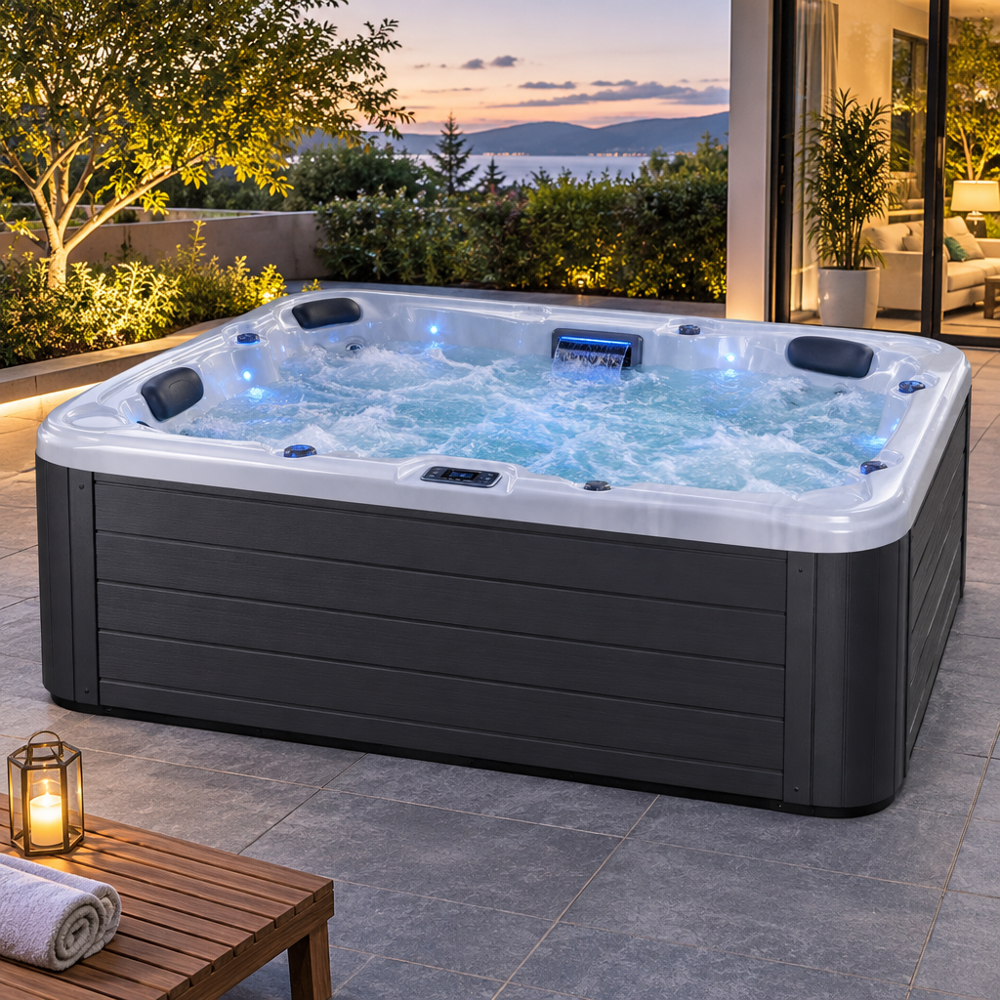
The specification lists two 3.0 HP jet pumps for the 66-jet system. While the dual-pump design provides substantial hydraulic force, users should consult the manufacturer’s hydraulic diagram or operating manual to verify exact plumbing manifold routing, seat-level pressure controls, and water flow distribution across individual therapy zones during active operation.
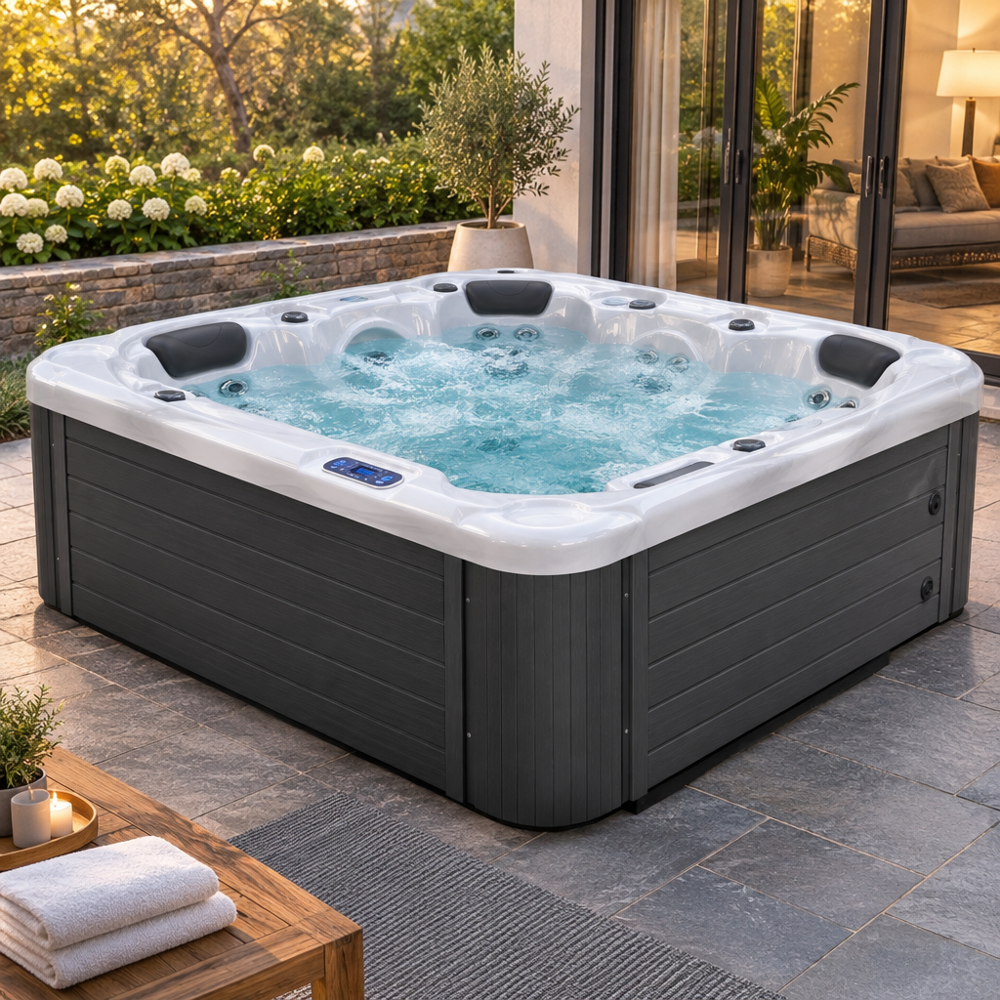
Maintaining pristine water clarity and sanitary safety forms the baseline of any reliable hydrotherapy installation. The ZR6007 integrates mechanical particle interception with ultraviolet (UV) treatment to help keep bathing water clean and clear during normal operation, preventing common water quality issues before they compromise bather comfort.
The specification lists one 0.35 HP circulation pump and one 100 sq. ft. cartridge filter to capture suspended debris. Clean or replace the 100 sq. ft. cartridge according to the manufacturer’s instructions, and use only compatible cleaning products to maintain proper hydraulic flow and water clarity over the intended service period.
As water circulates through the mechanical compartment, it passes through an inline UV sterilizer chamber. The integrated UV sterilizer is intended to provide supplemental treatment as water passes through the unit; its effectiveness depends on the installed device, flow rate, and maintenance. It does not replace the active chlorine or bromine residual required in the spa water.
Architectural integration with surrounding exterior environments requires adaptable cabinet styling. The product reference lists a weather-resistant New PS skirt in Gold Brown, Grey, and Black Stone, each featuring a textured wood-grain surface that integrates smoothly into diverse landscape settings.
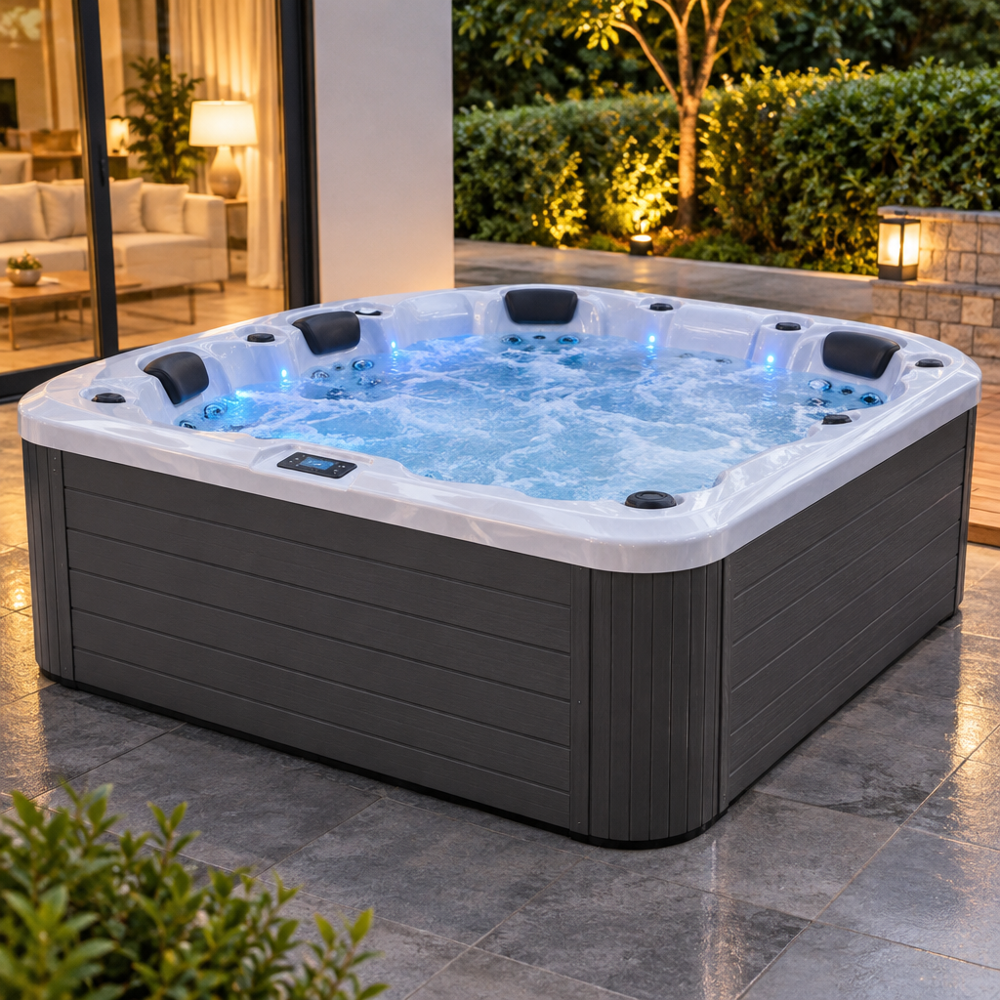
To complement the exterior cabinet, the molded US Aristech Acrylic shell is manufactured in seven distinct surface finishes: Gypsum, Odyssey, Oyster Opal, Mediterranean Sunset, Midnight Opal, Silver White Marble, and Midnight Canyon. These varied textures allow property owners to match either modern minimalist stone patios or classic garden deck settings.
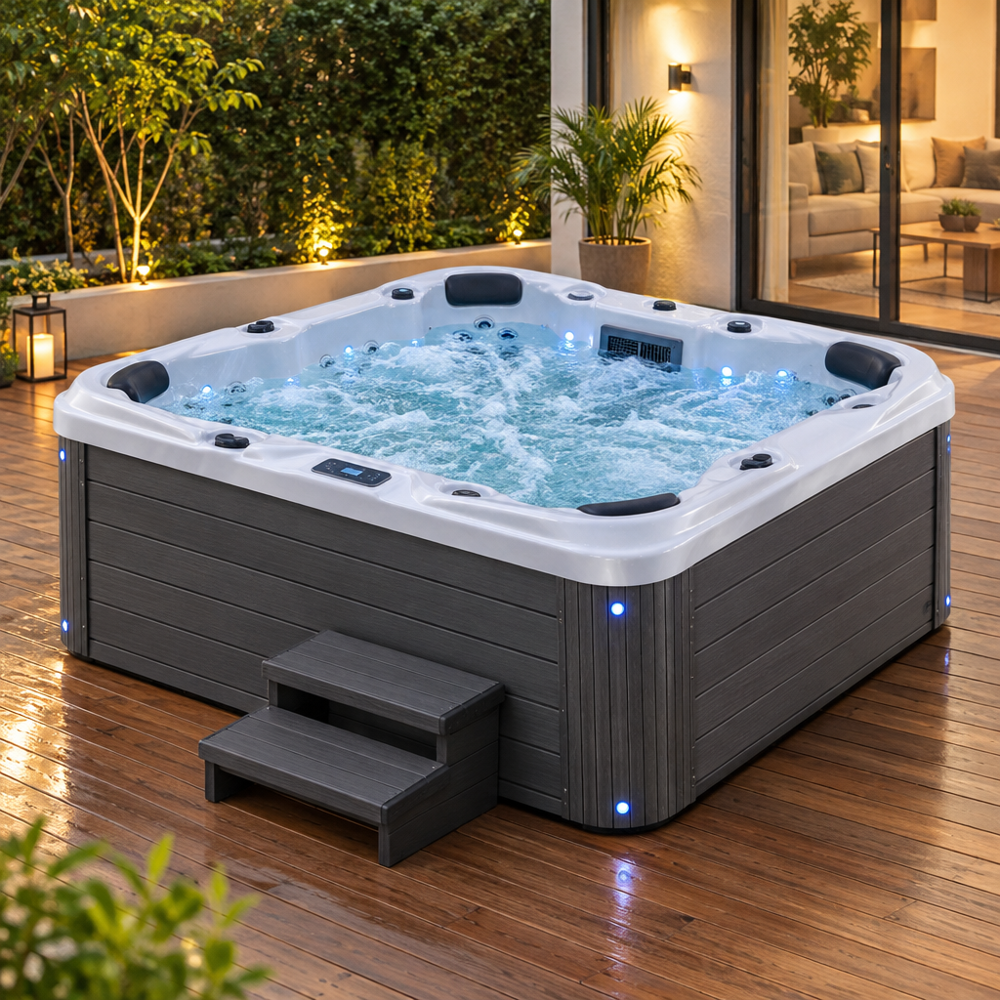
For evening hydrotherapy sessions, the ZR6007 incorporates an integrated multi-color LED waterfall fixture that arcs water into the main tub basin. This visual element enhances the patio environment, casting soft, colorful reflections across the water during night soaks and turning ordinary backyards into inviting wellness retreats.
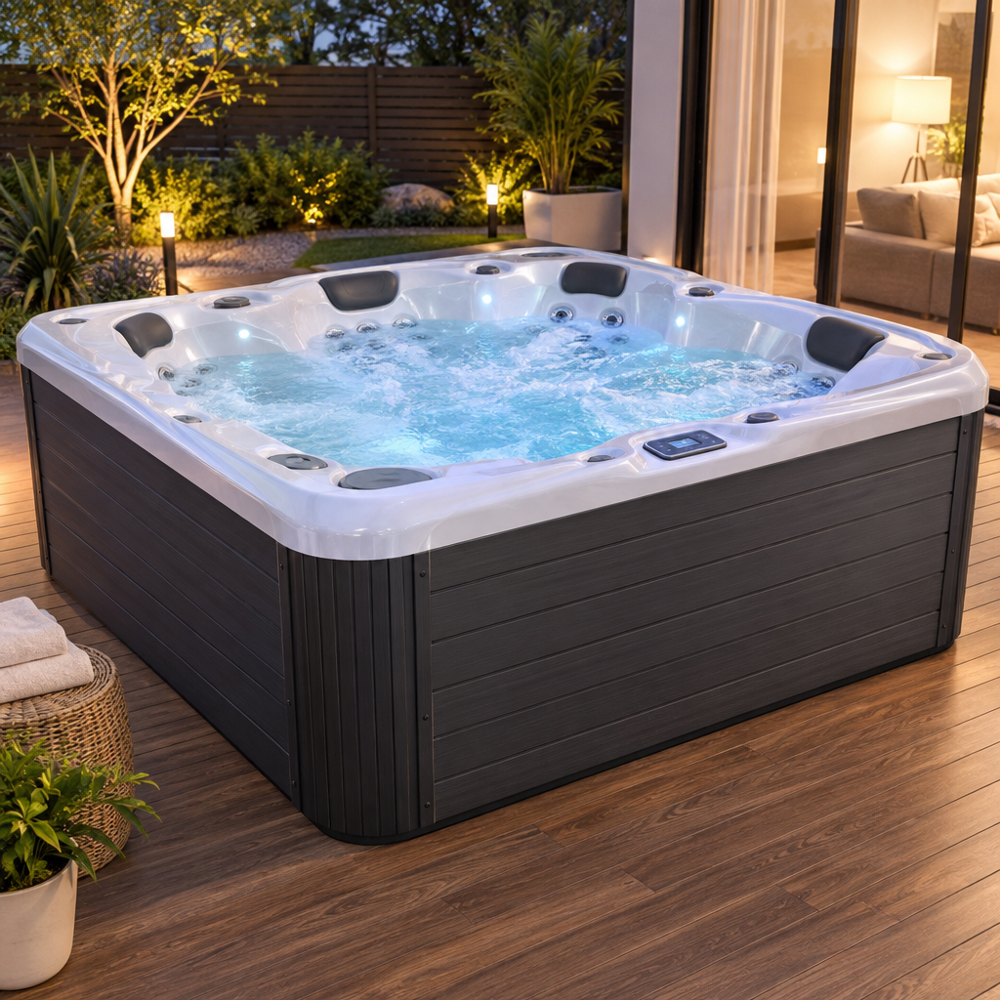
Never position a multi-person whirlpool spa tub on unprepared soil, bare lawn surfaces, or loose decorative gravel. The concentrated physical mass of a filled spa tub requires a rigid, level, engineered foundation to prevent uneven settlement, structural shell distortion, or pipe joint failure.
The empty ZR6007 weighs 410 kg, and its filled operating weight reaches 2210 kg with water. Adding seven adult bathers averaging 75 kg each brings the total estimated static load to approximately 2735 kg across its 2.3 m × 2.3 m footprint (yielding an approximate distributed pressure of 517 kg/m²). This is a rough static-load estimate, not a structural approval; a qualified professional must verify the slab, deck, soil, drainage, and load distribution.
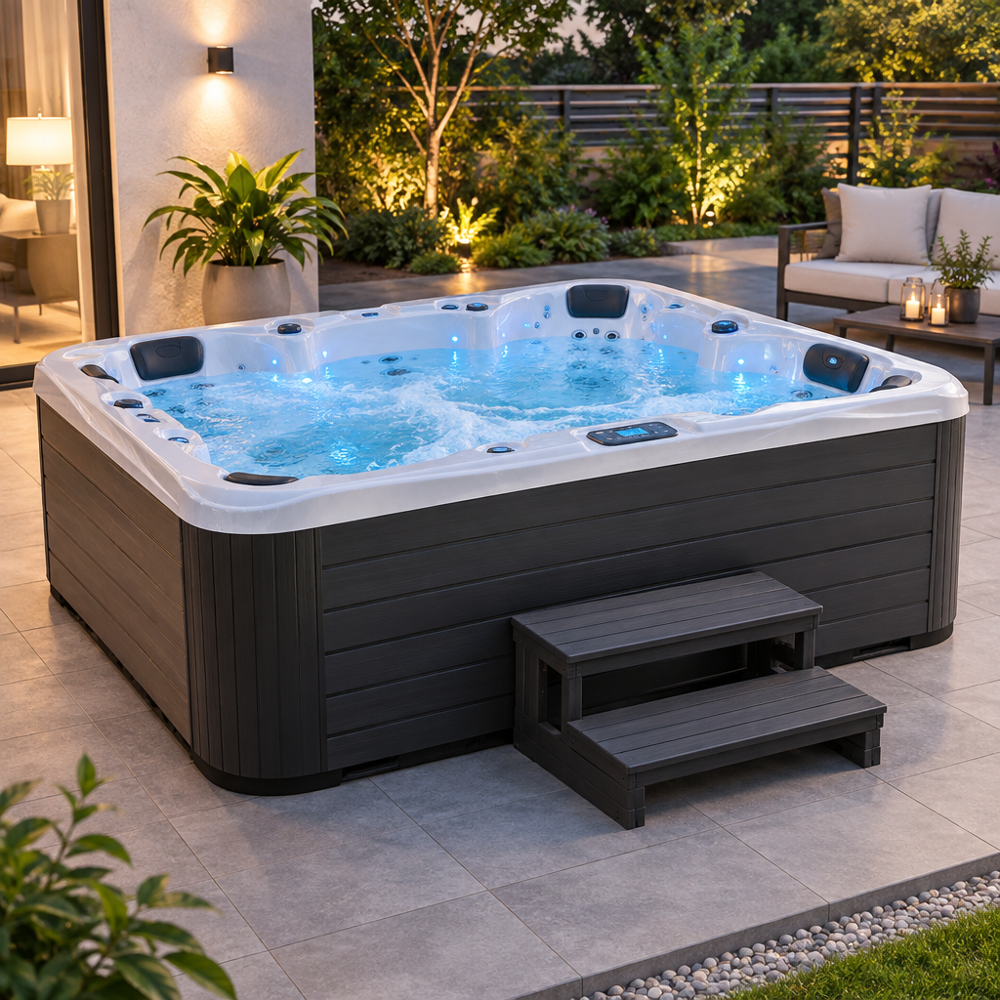
Connecting a multi-pump whirlpool spa tub requires strict adherence to national and local electrical safety regulations. All high-voltage electrical work must be performed by a licensed electrician to safeguard equipment reliability and protect bathers from electrical hazards.
The installation must use the electrical protection and disconnect arrangement required by the local electrical code, such as a GFCI or RCD where applicable, installed by a licensed electrician. This safety mechanism monitors current flow, interrupting power within milliseconds if an imbalance occurs, preventing accidental electrical shock.
The product specification lists 110 V, 220 V, and 380 V options, but the actual voltage, phase, breaker, disconnect, maximum current, and heater/pump load-shedding behavior must be confirmed with the manufacturer and a licensed electrician for the installation region. The Balboa BP6013G2 control platform and TP600 topside interface display system messages and water temperatures clearly.
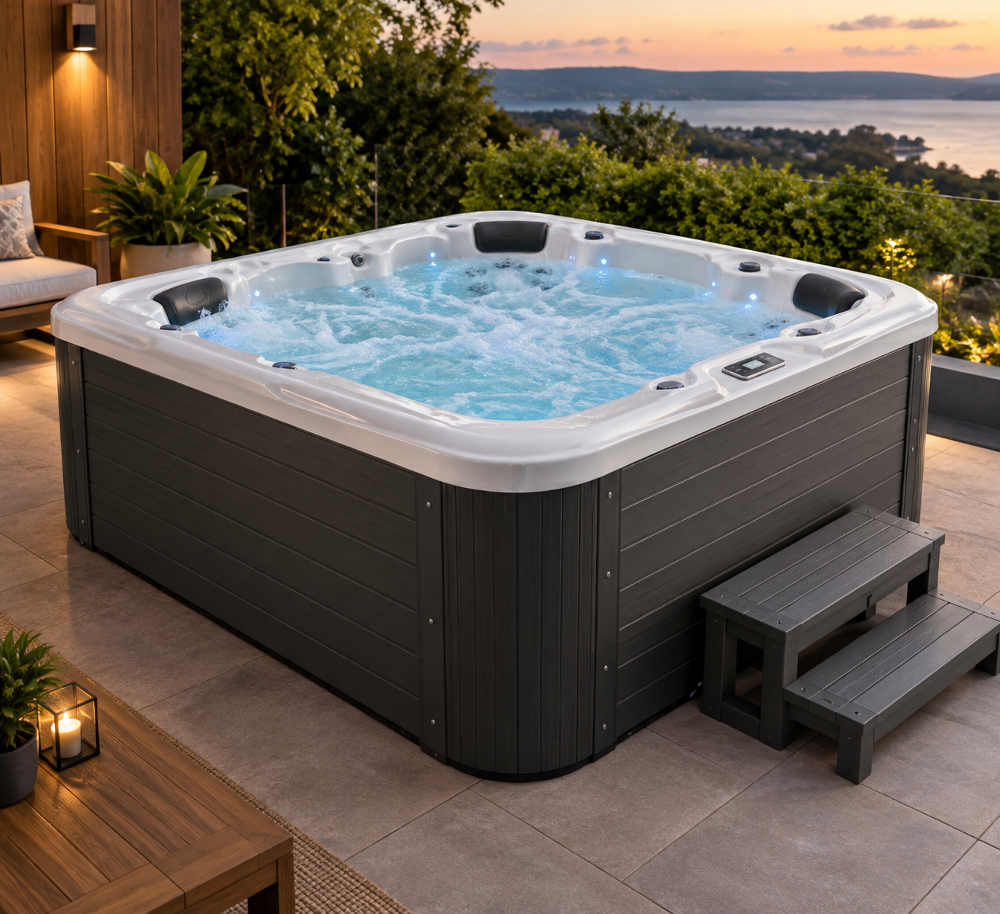
Planning equipment access corridors around the spa cabinet prevents costly headaches during routine maintenance. The mechanical compartment behind the exterior skirts contains the pumps, 3 kW heater, plumbing unions, and the Balboa control pack, all of which require periodic inspection.
Installers should leave at least 600 mm (24 inches) of clear working space around the perimeter of the cabinet. If the spa tub is recessed into an elevated timber deck or stone terrace, removable trap doors or surrounding trenches must be incorporated to ensure technicians can service mechanical components without requiring crane removal.
Plan a safe drainage method before installation. Confirm whether the supplied unit has a drain connection, and use an appropriate pump if required. Divert wastewater away from building foundations, basement window wells, and delicate landscape planting in compliance with local municipal runoff codes.
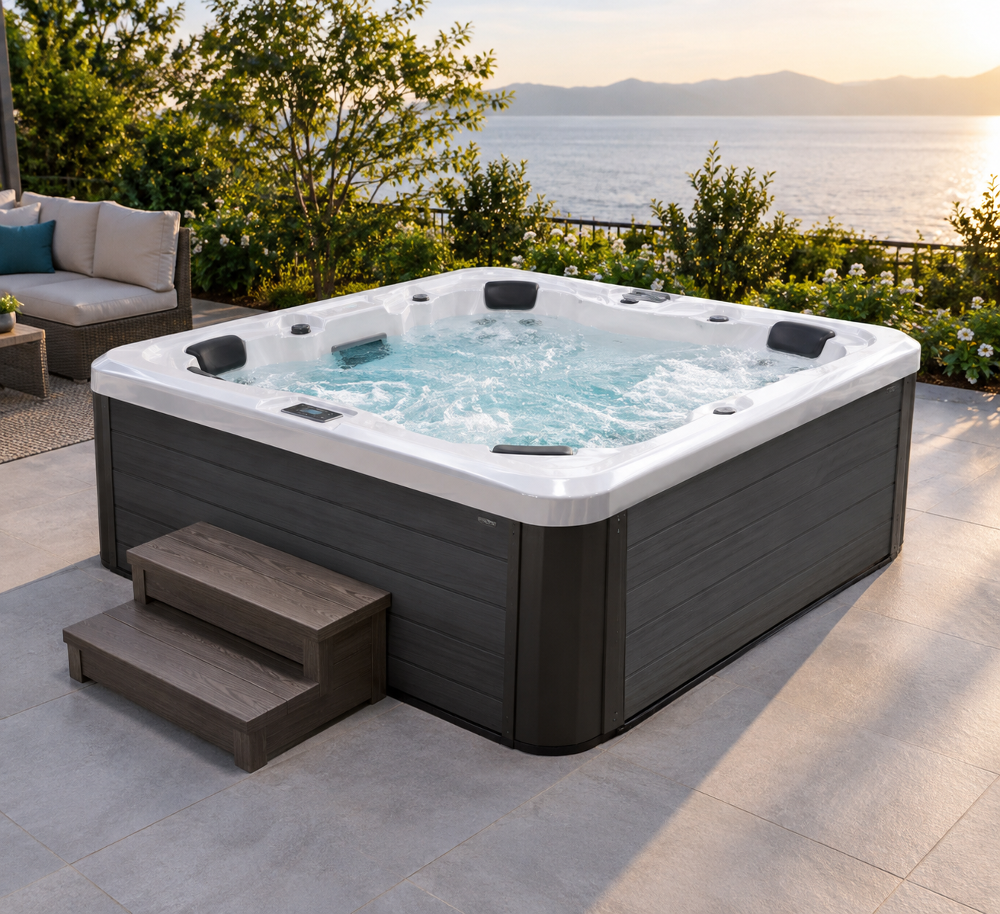
Because an outdoor whirlpool spa tub maintains elevated water temperatures between 37°C and 40°C (98.6°F to 104°F), warm water creates a favorable environment for microbiological growth and mineral scale deposition if left unmanaged. Regular water testing two to three times per week maintains essential chemical targets:
Warm, vigorously agitated water produces aerosolized droplets that bathers readily inhale during normal hydrotherapy use. Without appropriate residual disinfection, opportunistic pathogens such as Legionella pneumophila or Pseudomonas aeruginosa can colonize internal flexible PVC pipes, forming stubborn biofilms.
Secondary sanitizers, including UV sterilizers, provide valuable supplemental treatment within their physical reaction tubes, but they do not maintain a disinfectant residual in the open tub basin. Maintaining a continuous halogen residual (chlorine or bromine) is essential to neutralize pathogens introduced by bathers in real time.
Use a plumbing-cleaning product only when recommended by the manufacturer or when maintenance conditions require it, following the chemical label and flushing instructions. This chemical flush helps strip biofilm and scale accumulation from the hidden interior surfaces of the flexible plumbing lines.
Established public health directives specify that hot tub water temperatures must never exceed 104°F (40°C). Prolonged immersion in excessive water temperatures can cause hyperthermia, heat exhaustion, lightheadedness, or fainting.
As a cautious general practice, bathers should monitor their personal comfort and exit the spa immediately if they experience dizziness, nausea, or overheating. Some users choose temperatures below the 104°F maximum for extended relaxation sessions. Public health guidance advises that children under 5 should not use hot tubs, older children require close adult supervision and the manufacturer’s age guidance, and pregnant individuals or people with relevant cardiovascular conditions must consult a healthcare professional before use. Confirm that every suction fitting and drain cover is intact, properly secured, and compliant with the applicable anti-entrapment standard; do not operate the spa with a damaged or missing cover.
Selecting an outdoor whirlpool spa tub model requires an organized evaluation process:
Lovia is an outdoor spa brand specializing in the design, manufacturing, and wholesale of outdoor hot tubs, swim spas, and cold plunge tubs. We have an experienced technical team, coupled with cutting-edge manufacturing equipment, to ensure that every spa tub product we produce meets the highest standards in the industry. As a well-known manufacturer in the hot tub spa industry, our products are certified by CE, ETL, SAA, ROHS, REACH, ISO9001, and other international standards.
An indoor jetted bathtub connects directly to domestic municipal supply lines and household drains, emptying its water completely after every bathing session. An outdoor whirlpool spa normally retains treated water and may include pumps, filtration, heating, UV treatment, and a cover, depending on the model. The ZR6007 specification lists a UV sterilizer but does not list automated chemical dosing or a supplied cover.
The LOVIA ZR6007 is designed to seat up to seven adults across its multi-level interior seating contours. The manufacturer’s product page lists the ZR6007 as a 7-person spa with 7 seats, despite the contradictory "5 Person" page title, confirming seven dedicated molded seating positions complete with four soft cervical headrest cushions and a shared central footwell.
A filled spa tub, combined with seven bathers, exerts an estimated static mass of approximately 2735 kg on its installation base. A level, properly designed concrete pad is one common option; thickness and reinforcement must be specified for the site by a qualified contractor or engineer. Reinforced timber decks require professional engineering approval, and compacted gravel beds must have adequate structural containment.
The product lists 110 V, 220 V, and 380 V options, but the actual voltage, phase, breaker, disconnect, maximum current, and heater/pump load-shedding behavior must be confirmed with the manufacturer and a licensed electrician for the installation region. Operating parameters vary significantly based on whether the 3 kW heater and dual 3.0 HP pumps run simultaneously.
No, ultraviolet sterilization does not replace chemical sanitizers entirely. The integrated UV sterilizer is intended to provide supplemental treatment as water passes through the unit; its effectiveness depends on the installed device, flow rate, and maintenance. Because UV light leaves no chemical residual in the tub basin, bathers must maintain an active chlorine residual (3–5 ppm) or bromine residual (4–8 ppm) to keep standing water sanitary.
Established pool and spa safety guidelines mandate that water temperature should never exceed 104°F (40°C). Some users choose temperatures below the 104°F maximum for comfort. Operating above 104°F increases the risk of hyperthermia, heat stroke, and lightheadedness. Public health guidance advises that children under 5 should not use hot tubs, and pregnant individuals or people with medical conditions must consult a doctor before use.
Drain and refill according to the manufacturer’s instructions and actual bather load. The CDC formula can provide a planning estimate, but water should be changed sooner if clarity, chemistry, or contamination control cannot be maintained. High bather usage in commercial settings demands more frequent water changes regardless of elapsed calendar time.
Do not assume a standard deck can support the spa. A structural engineer must verify the filled unit, bathers, concentrated load, supports, and load path, and specify reinforcement if appropriate. Standard residential timber decks are generally built for light foot traffic and cannot support a multi-ton concentrated load without specialized framing.
A modern outdoor whirlpool spa tub delivers relaxation and physical comfort by combining hydrotherapy massage, thermal buoyancy, and reliable water filtration. The ZR6007 is specified for residential wellness settings and high-end commercial spa projects; suitability for a particular commercial installation depends on local code, bather load, maintenance, and commissioning requirements.
Achieving long-term satisfaction requires proper early site planning, including a level foundation, compliant electrical wiring, and consistent chemical water testing. By respecting structural load realities, hydraulic operating requirements, and routine maintenance protocols, property owners ensure their outdoor whirlpool spa tub operates cleanly, safely, and reliably throughout all four seasons.