

When you start searching for the cheapest swim spa on the market, your mind likely fills with visions of crisp morning laps and warm, bubbling hydrotherapy after a long day. It is a beautiful ambition. However, stepping into the entry-level budget tier of aquatic fitness requires a shift from pure emotional anticipation to cold, hard mechanical realism. Finding a low-cost model that actually delivers long-term value means looking past the glossy brochures. You must understand exactly where manufacturers trim the fat, ensuring you do not accidentally buy a glorified, oversized bathtub that drains your patience and your wallet.
Choosing the most affordable swim spa options invariably means accepting certain engineering trade-offs. In standard premium models, fiberglass shells are reinforced with layers of heavy-duty vinyl ester resins. Budget units, conversely, often rely on thinner acrylic sheets backed by less robust backing materials. This structural compromise does not mean the tub will crack on day one, but it does alter how the structure flexes under thousands of gallons of shifting water pressure.
Furthermore, the swimming current itself feels distinctly different. While high-end systems utilize complex variable-pitch propellers or wide-stream continuous pumps to create a smooth, river-like resistance, entry-tier units usually rely on standard directional hydrotherapy jets. This can result in a more turbulent, “choppy” swim current. For a casual swimmer or someone seeking low-impact aquatic aerobics, this jet-driven turbulence is perfectly manageable, but competitive athletes might find the perimeter resistance lacking the laminar flow necessary for high-intensity training.
Never compromise on the core mechanical nervous system. Even when scouting for a budget-friendly backyard swim spa, the internal plumbing architecture, control packs, and pump builds must remain uncompromised. Maintaining a baseline of industry-standard reliability—such as integrating genuine Balboa or Gecko control systems—is non-negotiable for operational safety.
| Essential Component | Budget Standard | What to Avoid |
|---|---|---|
| Control System | Certified global brands (e.g., Balboa) | Unbranded, proprietary generic boards |
| Plumbing Pipes | High-flex food-grade PVC | Rigid, thin-walled plastic tubing |
| Support Frame | Treated stainless steel or pressure-treated wood | Untreated light-gauge aluminum frames |
| Shell Lining | Multi-layer Lucite or Aristech Acrylic | Single-layer vacuum-formed plastics |
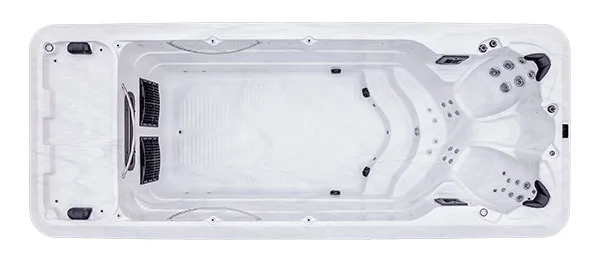
A high-quality pump should feature robust insulation wrapped around its copper windings. If a manufacturer uses sub-par impellers to cut costs, the motor will work twice as hard, running hotter and failing years ahead of its time. Look closely at the frame infrastructure beneath the shell; a galvanized steel or heavily treated support system is paramount to prevent sagging.
The true cost of the cheapest swim spa clearance deals is rarely paid at the checkout counter; it crawls into your monthly utility bills. Cheap manufacturing often saves upfront capital by spraying a bare minimum of low-density perimeter foam insulation. In cold climates, this cutting of corners transforms your swim spa into a massive thermal radiator, bleeding heat directly into the freezing ground and surrounding air.
Consider the ambient heat recovery principle used in commercial hydrotherapy facilities. Efficient systems capture the natural kinetic heat generated by the running pumps, channeling that warmth back into the water lines. Cheap models lack this thermal loop, forcing the electric heater to run continuously. Over three or four years, the cumulative electricity costs of an improperly insulated budget spa can easily outpace the initial purchase price of a properly engineered, mid-tier alternative.
Owning an economical unit demands a disciplined, almost ritualistic approach to water chemistry and sanitation. Premium spas often feature advanced, automated multi-stage ozone or UV-C purification loops that aggressively destroy organic contaminants on a molecular level. Lower-cost units typically depend on simpler, passive cartridge filtration setups.
[Daily: Check Sanitizer Levels] ──> [Weekly: Clean Filters & Shock] ──> [Quarterly: Deep Shell Flushing]
Because the filtration turnover rate might be slower, you cannot afford to neglect chemical balances. A slight shift in pH can cause scale buildup inside the heating element, a vulnerability that affordable titanium heaters succumb to far quicker than expensive Incoloy variations. Regularly rinsing the pleated filter cartridges and utilizing a heavy-duty, commercial-grade thermal cover will dramatically reduce both chemical evaporation and structural strain on your filtration pump.
Investing wisely in the cheapest swim spa arena is entirely possible if you prioritize structural integrity over superficial design accents like perimeter LED light shows or integrated Bluetooth speaker arrays. By focusing your budget on certified internal components and committing to rigorous preventative maintenance, you can secure a reliable, restorative aquatic sanctuary without overextending your financial boundaries.