

Thermal management remains the primary challenge for outdoor aquatic installations where heat loss through the water surface accounts for nearly seventy percent of total energy consumption. Finding the best swim spa covers requires a detailed understanding of how specialized materials interact with fluctuating ambient temperatures and high humidity levels. A cover is not merely a lid; it is a critical component of the unit’s insulation envelope that maintains water chemistry and structural safety.
The core of any high-performance cover is its expanded polystyrene (EPS) foam, which must provide a high R-value while resisting moisture absorption. Standard covers often fail because the foam becomes waterlogged over time, significantly increasing weight and decreasing the insulation capacity of the material. Premium designs utilize high-density foam that is vacuum-sealed in a chemically resistant vapor barrier to ensure long-term buoyancy and thermal performance.
Structural tapering is another essential engineering detail that prevents water from pooling on the surface during heavy rainfall or snow. A typical taper might range from five inches at the center to three inches at the edges, facilitating natural runoff and reducing the static load on the internal support channel. This geometry ensures that the best swim spa covers remain light enough for daily operation while standing up to harsh environmental stressors without sagging.
The internal support of a swim spa cover often consists of a galvanized steel or aluminum C-channel, which provides the necessary rigidity across the wide span of the unit. Without this reinforcement, the foam core would eventually crack under its own weight or the weight of accumulated debris. This metal skeleton is integrated directly into the foam assembly, creating a composite structure that distributes pressure evenly across the acrylic rim of the spa.
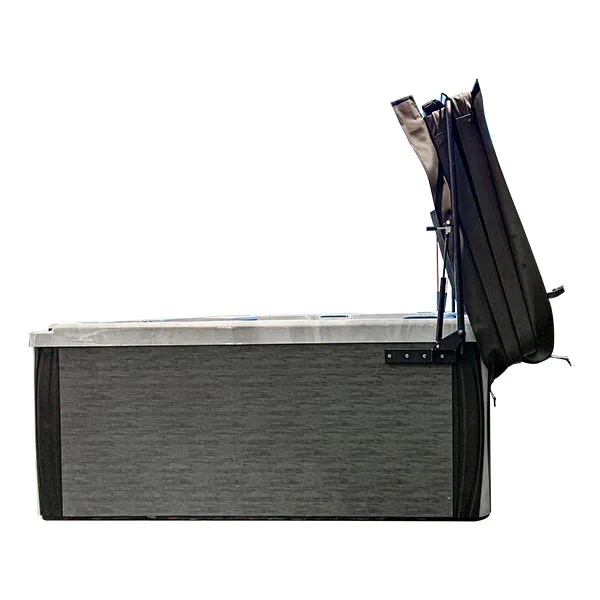
The physical dimensions of swim spas make manual handling of covers difficult, often leading to mechanical damage during opening and closing cycles. Integrating a mechanical assistance system, such as a hydraulic lifter, is essential for maintaining the integrity of the cover’s hinge and perimeter skirts. Guangzhou Huantong Industrial Co., Ltd., under its Lovia brand, engineers accessories like the Spa Cover Lifter to reduce physical strain and prevent the cover from dragging against abrasive patio surfaces.
By utilizing a pivot-point mechanism, the lifter allows the cover to transition smoothly into a vertical position, where it acts as a secondary windbreak or privacy screen. This controlled movement minimizes the risk of tearing the outer vinyl or compromising the internal vapor seal. Proper installation of these mechanical arms ensures that the best swim spa covers can be operated by a single person without compromising safety or structural alignment.
The outer skin of a cover must withstand constant exposure to ultraviolet radiation and oxidative stress from pool chemicals like chlorine and ozone. Marine-grade vinyl remains the industry standard, but the specific formulation must include UV inhibitors and antimicrobial agents to prevent fading and mildew growth. Specialized top-coats are often applied to provide a hydrophobic surface that sheds water and prevents the accumulation of organic debris that could rot the fabric.
| Technical Specification | Standard Requirement | High-Performance Grade |
|---|---|---|
| Foam Density | 1.0 lb/ft³ | 2.0 lb/ft³ |
| Tapered Thickness | 4″ to 2″ | 5″ to 3″ |
| Vapor Barrier | Single Layer PE | Double Layer Mylar-Reinforced |
| Reinforcement | None | Integrated Aluminum C-Channel |
| UV Resistance | 500 Hours | 1500+ Hours |
Why does my swim spa cover feel heavy after a few years?
Weight gain is typically caused by moisture ingress into the foam core, which occurs when the internal vapor barrier is punctured or degraded by chemical exposure.
How does cover thickness affect energy bills?
A thicker, better-tapered cover provides a higher R-value, significantly reducing the frequency of heater activation and lowering monthly electricity costs in colder climates.
Can a cover lifter be installed on any swim spa?
Most hydraulic lifters are adjustable, but they require a specific clearance behind the unit to allow for the vertical storage of the cover when the spa is in use.
Selecting the best swim spa covers involves evaluating the synergy between material durability and mechanical support systems. A cover that balances heat retention with ease of use will protect the internal components of the spa while providing a safer environment for users. Investing in high-density insulation and robust surface materials ensures that the aquatic system remains efficient and functional for many seasons without the need for premature replacement.